
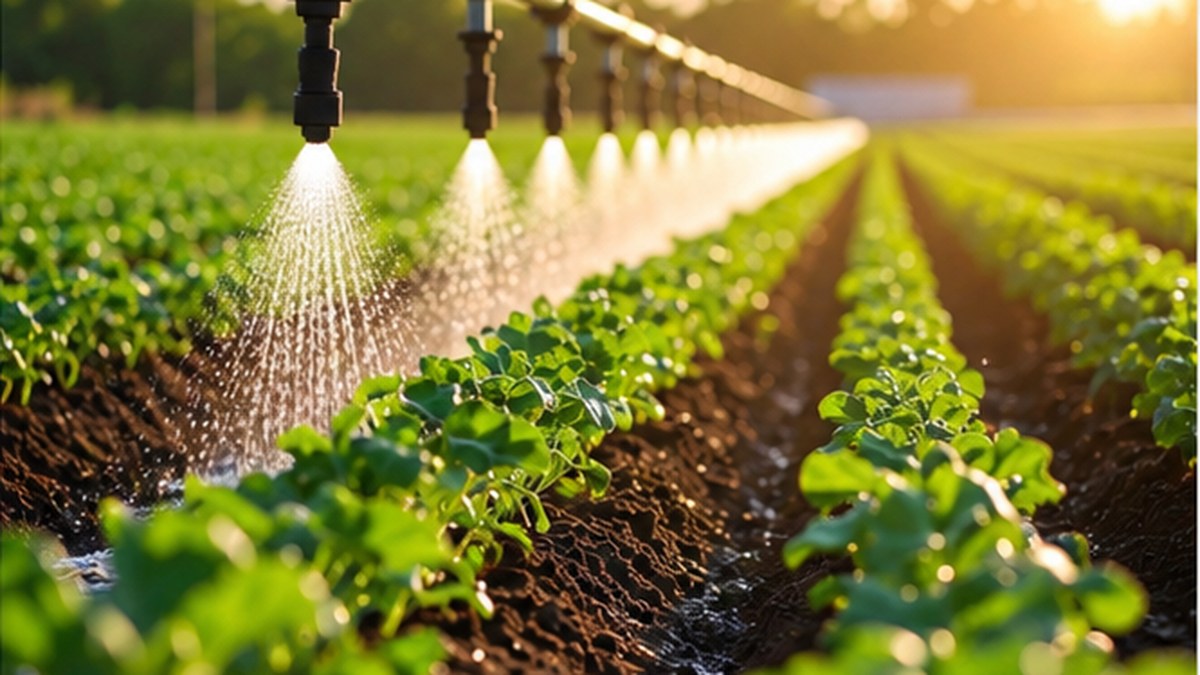
Saving water sounds like an obvious financial advantage. An irrigation system that applies less water should cost less to operate, use resources more efficiently, and potentially improve farm profitability. Yet agricultural research shows that the relationship is not always so straightforward.
In a series of field trials conducted in Nebraska in 2024, irrigation scheduling tools reduced water applications without significantly affecting crop yields. However, the researchers found no statistically significant improvement in marginal net returns. The technology demonstrated an operational benefit, but its financial advantage was less certain.
This distinction lies at the heart of evaluating smart irrigation ROI. Agricultural businesses are increasingly able to monitor soil conditions, automate irrigation operations, and manage water applications with greater precision. What remains more challenging is determining whether those capabilities create enough measurable value to justify the investment.
The financial stakes are substantial. According to the USDA’s 2023 Irrigation and Water Management Survey, American farms applied approximately 81 million acre-feet of irrigation water in 2023, with pumping energy expenditures reaching $3.3 billion. Meanwhile, Statistics Canada reported that Canadian farms used nearly 1.9 billion cubic metres of irrigation water in 2024.
For agricultural decision-makers, the question is not simply how much water a technology promises to save. It is where that saving creates economic value, which operational problems the technology addresses, and whether the expected benefits justify its costs under real farming conditions.
The Real Economics Behind Smart Irrigation
Smart irrigation encompasses technologies that use monitoring, agricultural data, decision-support systems, and automated controls to improve irrigation management. These systems can help operators determine when irrigation is needed, estimate crop water requirements, remotely control equipment, or adjust water applications across different parts of a field.
Although these capabilities are often grouped under one technological category, their economic value depends on the problems they solve.
Consider two commercial farms installing identical soil moisture monitoring systems. The first already follows an effective irrigation schedule, maintains reliable equipment, and incurs relatively low pumping expenses. The second experiences frequent overirrigation, expensive pumping operations, and recurring uncertainty about soil water availability.
Both farms may receive equally accurate information from the technology, but the second has greater potential to eliminate avoidable costs. The difference is not necessarily the sophistication of the equipment; it is the gap between current performance and achievable improvement.
That gap is fundamental to agricultural investment decisions. A technology that improves operational precision is valuable only to the extent that the improvement addresses a meaningful production, resource-management, or business challenge.
Water Savings Are Not the Same as Financial Savings
Water efficiency is important, but the economic implications depend on how water is obtained, priced, and applied. A farm paying fixed annual water charges may not reduce those charges simply by applying less water. A farm pumping groundwater with substantial variable energy costs may experience more direct savings when irrigation demand decreases.
There is also an environmental distinction between reducing water applications and reducing water consumption. Some irrigation water returns to rivers or aquifers, while other portions are consumed through evaporation and crop transpiration. As explained by the U.S. Geological Survey, water withdrawals and consumptive use represent different dimensions of agricultural water management.
This means a reduction measured at the irrigation system does not necessarily translate into an equivalent reduction in watershed-level water consumption.
For agricultural businesses, these differences matter because operational savings, financial returns, and environmental benefits should be evaluated separately. They may reinforce one another, but they are not interchangeable.
Not All Smart Irrigation Technologies Have the Same Economics
Smart irrigation is not a single investment category. Monitoring, scheduling, automation, and variable-rate irrigation provide different capabilities and therefore require different economic justifications.
Understanding these differences helps agricultural businesses avoid paying for technological complexity that does not address their actual operational needs.
Soil Moisture Monitoring and Irrigation Scheduling
Soil moisture monitoring systems measure or estimate water conditions within the crop root zone. Some sensors measure volumetric water content, while others measure soil water tension, which indicates how difficult it is for plant roots to extract water. Scheduling tools may combine these measurements with rainfall, crop-development information, and evapotranspiration estimates to support irrigation decisions.
Evapotranspiration, or ET, refers to water transferred to the atmosphere through evaporation and plant transpiration. Understanding this process helps operators estimate crop water demand and determine when irrigation may be necessary.
The University of Minnesota Extension describes different monitoring technologies, each with its own installation requirements, calibration considerations, and operating limitations. Their effectiveness depends not only on sensor accuracy but also on representative placement, appropriate interpretation, and the ability to act on the information.
From an investment perspective, the critical question is whether better information leads to better decisions. Monitoring may reduce unnecessary irrigation, help prevent costly crop stress, or support more consistent management. However, where existing scheduling practices are already effective, additional data may generate limited financial improvement.
Collecting more agricultural data does not automatically create more business value.
Automated Irrigation Controls
Automation adds the ability to operate pumps, valves, and irrigation zones remotely or according to predefined schedules and sensor-based instructions. Its economic value can extend beyond water savings to include reduced manual intervention, fewer vehicle trips, and more consistent irrigation operations.
This may be particularly relevant to farms managing multiple irrigation sites or geographically dispersed fields. When employees repeatedly travel to equipment locations to adjust valves, inspect systems, or respond to changing conditions, automation can reduce operational demands and make staff time available for other activities.
However, eliminating a manual task is not always equivalent to reducing an operating expense. If staff remain employed at the same cost, the direct financial saving may be limited, although the ability to redirect their time toward other productive work may still be valuable.
Automation also introduces costs and dependencies, including controllers, communication infrastructure, software services, maintenance, and technical support. Agricultural operators must consider system compatibility, connectivity reliability, and their ability to maintain manual control when automated components fail.
The strongest investment case arises when automation resolves a measurable operational constraint rather than simply replacing a functioning manual process with a more sophisticated one.
Variable-Rate Irrigation
Variable-rate irrigation (VRI) allows water applications to differ across management zones within a field. This capability is intended to address spatial differences in soil properties, water-holding capacity, and crop-water requirements.
Its potential value is closely linked to field variability. Where soil and crop conditions are relatively uniform, an effective conventional irrigation schedule may already deliver suitable results. Where meaningful differences exist across a field, VRI may offer opportunities to allocate water more precisely.
However, field variability alone does not guarantee that VRI will be economically attractive. The differences must be significant enough to influence irrigation decisions, the equipment must be capable of responding appropriately, and the resulting improvements must justify additional installation and management costs.
The practical distinction is important: irrigation scheduling improves decisions about when and how much to irrigate; VRI adds the capability to vary applications spatially.
For agricultural businesses, advanced spatial control should therefore be evaluated as a solution to a specific field-management problem, not simply as the next technological upgrade.
What Determines Whether Smart Irrigation Pays Off?
The same irrigation technology can generate substantially different returns depending on the production system, operating environment, and management practices already in place.
Rather than relying on advertised savings percentages, agricultural decision-makers should evaluate the conditions that determine whether those savings translate into meaningful value.
Water and Energy Costs
The financial value of reducing irrigation depends partly on the cost structure of water delivery. Groundwater depth, pumping efficiency, electricity or fuel prices, required system pressure, and water supply arrangements can all influence operating expenses.
A reduction in irrigation volume may generate substantial savings where pumping is expensive and energy consumption decreases accordingly. In other operations, fixed water charges or limited changes in actual pumping requirements may reduce the financial impact.
Water availability introduces another consideration. Where water shortages or allocation limits constrain production, better scheduling may help protect crop performance or make limited supplies available when they are most valuable.
These benefits should be assessed separately from direct pumping-cost savings. Otherwise, an investment model risks overstating returns by counting the same operational improvement more than once.
Labour and Operational Efficiency
The value of automation often depends on the complexity of existing irrigation operations. Farms with numerous irrigation zones, extensive travel requirements, or limited seasonal labour may benefit from reducing repetitive tasks and improving remote access to equipment.
However, decision-makers should distinguish between actual reductions in expenditure and improvements in staff productivity. Avoided overtime, fewer paid service visits, or reduced seasonal labour requirements may generate identifiable financial savings. Time that becomes available for other responsibilities creates potential value, but its financial contribution depends on how that time is used.
Operational reliability also matters. Faster responses to equipment problems or unexpected field conditions may be valuable, particularly where delays could affect production. These benefits can be difficult to estimate in advance and should be supported by operating records or conservative assumptions.
Crop Value, Yield, and Quality
The financial consequences of irrigation management differ considerably between crops. For high-value agricultural products, preventing water stress or protecting marketable quality may be economically important, even when total irrigation savings are modest.
Yet yield improvement should not be assumed simply because a new technology offers more precise control. Where existing irrigation already maintains suitable soil-water conditions, additional monitoring or automation may not increase production.
The greatest opportunity may arise where current irrigation limitations contribute to crop stress, production variability, or avoidable quality losses. In such cases, the relevant economic question is whether improved management can reliably reduce those losses.
Agricultural decision-makers should therefore distinguish between potential agronomic benefits and demonstrated financial results. Both matter, but evidence supporting one does not automatically establish the other.
Existing Infrastructure and Management Performance
A technology investment should also be assessed against the condition of the farm’s existing irrigation infrastructure.
Poor pressure regulation, worn components, uneven water distribution, or insufficient maintenance may undermine irrigation performance regardless of how sophisticated the monitoring system becomes. Investing in better data without correcting these physical limitations may deliver disappointing results.
Similarly, a farm already operating an effective irrigation schedule may have less room for improvement than an operation relying on inconsistent or reactive management decisions.
The relevant benchmark is not an idealized farm with no technology. It is the farm’s actual performance and the most practical alternatives available for improving it.
Key Insight — The Three-Test Investment Screen
Before assigning financial value to projected irrigation savings, agricultural decision-makers should ask:
- Does the expense actually change? A reduction in water use or labour hours is not necessarily a reduction in expenditure.
- Can the proposed technology influence it? The system must address the specific operational constraint generating the cost or risk.
- Can the improvement be measured? Expected benefits should be evaluated against existing performance rather than generalized industry assumptions.
If a projected benefit fails these tests, it should not automatically be counted as a financial saving.
What Field Research Reveals About Returns
Research provides valuable evidence of smart irrigation’s potential, but also demonstrates why results cannot be generalized across every agricultural operation.
Three recent investigations illustrate different relationships between irrigation efficiency, crop performance, and financial outcomes.
Nebraska: Less Water Without a Significant Profit Difference
In 2024, the University of Nebraska On-Farm Research Network conducted four field trials comparing growers’ usual irrigation decisions with those supported by a commercial scheduling tool.
The tool-managed areas received an average of 1.2 inches less irrigation than grower-managed areas. Researchers found no statistically significant differences in crop yields or marginal net returns between the two approaches.
The finding demonstrates an important operational opportunity: irrigation applications may sometimes be reduced without sacrificing production. However, the financial results were not sufficiently different to establish a significant profitability advantage under the conditions studied.
For commercial growers, the lesson is not that scheduling tools lack economic value. It is that the importance of water savings depends on their operating costs, existing management practices, and the value of reducing resource demand.
These findings are based on four corn and soybean trials during one growing season and should be interpreted within that context.
South Carolina: Promising Results With Important Financial Qualifications
A 2026 peer-reviewed study by Payero and colleagues examined soil-water monitoring systems across commercial farms in South Carolina between 2020 and 2022.
Researchers initially evaluated 18 site-years, comparing sensor-guided irrigation with companion fields managed according to growers’ usual practices. Seven site-years were excluded from the principal comparison because field-specific conditions limited comparability.
Across the remaining 11 site-years, the researchers reported average crop-yield improvements of 11% and increases of 12.2% in their calculated net economic returns.
The findings suggest that sensor-guided irrigation can improve production outcomes under suitable conditions. However, the economic figures require careful interpretation.
The study defined net economic return using crop revenue less irrigation energy costs. It did not represent a complete farm-profit calculation, and the monitoring system’s capital and maintenance costs were excluded because participating farmers received the equipment and services without charge.
The excluded site-years also matter when interpreting the reported averages. They included situations involving differences in crop varieties, field conditions, and management practices that made direct comparisons difficult. Consequently, the selected results should not be treated as representative of every observation or as evidence of guaranteed yield improvement.
For agricultural investors and operators, this distinction is essential. A technology may improve crop performance or selected operating returns without automatically delivering a positive return after acquisition, integration, and maintenance costs.
Variable-Rate Irrigation: When Greater Precision Is Not Economically Justified
A separate 2026 study by Sharma, Irmak, and Kranz evaluated the long-term economic feasibility of variable-rate irrigation using field data and AquaCrop modelling.
The researchers compared different VRI strategies with conventional uniform irrigation management across modelled soil conditions and cost scenarios.
Under the evaluated assumptions, VRI reduced annual irrigation by an average of 2.4%, but the savings were insufficient to justify its additional costs. The study reported an approximately 4% annual economic disadvantage relative to conventional uniform management at the assessed costs.
Importantly, the researchers also identified conditions under which VRI became more attractive, particularly where suitable field variability existed and investment costs were reduced.
The finding challenges a common assumption in agricultural technology adoption: that greater technological precision necessarily produces better financial performance.
It also highlights the importance of evaluating simpler alternatives. In some circumstances, improving conventional irrigation scheduling may produce more attractive economic results than installing advanced variable-rate controls.
Because the results were based on a field-informed modelling exercise, they should not be interpreted as a universal prediction for all VRI installations.
What Commercial Implementations Add
Commercial installations provide another perspective, particularly where automation addresses labour requirements and infrastructure-management challenges.
A 2025 Cal.net case study reported that irrigation automation covering approximately 400 acres of processing tomatoes at California’s Terranova Ranch reduced water use by 34% and generated more than $61,000 in first-year operational savings.
The supplier attributed the benefits to reductions in water use, labour requirements, and vehicle-related expenses. These figures are company-reported rather than independently audited, and should not be treated as representative performance benchmarks.
Nevertheless, the case illustrates an important investment consideration: irrigation technology can generate value through several operational improvements, not exclusively through reduced water application.
Taken together, the research and commercial examples suggest that smart irrigation is best evaluated as a farm-specific operational investment. Its value depends on the problems it resolves, the costs it avoids, and the reliability of the improvements it delivers.
Research Comparison: Outcomes, Limitations, and Business Implications
The four sources offer different forms of evidence. Comparing them helps illustrate which questions agricultural businesses should investigate before investing, rather than establishing a ranking of technologies or financial returns.
| Evidence source and type | Key numerical findings | Important limitations | Practical business implications |
|---|---|---|---|
| Nebraska (2024) — University-led, replicated on-farm field trials; extension report | Across four corn and soybean trials, irrigation scheduling tools reduced applications by an average of 1.2 inches, without statistically significant differences in yield or marginal net returns. | Four fields, one growing season; financial results reflect the study’s assumed irrigation and technology costs. | Scheduling may reduce pumping requirements without reducing yield, but financial value depends on actual avoidable costs and the farm’s existing practices. |
| South Carolina (2020–2022) — Peer-reviewed observational on-farm demonstration | Across 11 selected site-years, average crop yield increased 11% and calculated net economic return increased 12.2% under sensor-guided irrigation. | Seven of 18 site-years excluded; no randomization or within-field replication. Net economic return was crop revenue minus irrigation energy cost; monitoring-system capital and maintenance costs were excluded. | Better scheduling may protect or improve production, but a purchase decision requires full system costs and realistic farm-specific yield assumptions. |
| VRI economic analysis (2026) — Peer-reviewed, field-informed simulation and economic modelling | Average annual irrigation reduction of 2.4%; approximately 4% annual economic disadvantage relative to conventional uniform irrigation at the assessed costs. | Modelled field and soil conditions, irrigation strategies, and technology-cost assumptions; not a universal estimate of VRI performance. | Evaluate field variability and additional control costs before investing; effective uniform scheduling may be the more economical alternative. |
| Terranova Ranch (2025) — Supplier-reported commercial case study | On approximately 400 acres of processing tomatoes, the supplier reported 34% less water use and more than $61,000 in first-year operational savings. | Supplier-reported outcomes, not independently audited; the published summary does not establish an independently verified full-investment ROI. | Automation’s value may extend to labour and vehicle costs, but results require verification against actual baseline expenses and technology costs before transfer to another farm. |
Research comparison note: These results measure different outcomes—including irrigation application depth, crop yield, selected economic returns, modelled financial performance, and supplier-reported operating savings. The figures are not directly comparable and must not be interpreted as relative technology rankings or expected ROI benchmarks.
How to Evaluate a Smart Irrigation Investment
An effective investment assessment should help agricultural businesses decide whether a technology is necessary, which level of sophistication is appropriate, and how confidently its expected benefits can be justified.
This does not require beginning with a complex financial model. It requires understanding the operation’s existing limitations and identifying the most credible opportunities for improvement.
Establish the Operating Baseline
Before evaluating a new system, operators should document how their current irrigation practices perform. Relevant information includes water applications, pumping energy, labour requirements, irrigation-related maintenance, crop performance, and recurring operational problems.
Where possible, data should cover more than one growing season to distinguish persistent inefficiencies from weather-related variation.
The purpose is not merely to collect historical information. It is to identify which problems are significant enough to justify intervention.
For example, if substantial pumping costs are associated with avoidable irrigation applications, improved scheduling may deserve consideration. If repetitive site visits are consuming staff time, remote automation may offer more relevant benefits.
Compare Technologies Against Practical Alternatives
Investment decisions should evaluate more than one possible solution.
A farm experiencing irrigation scheduling problems might compare improved manual scheduling, soil moisture monitoring, and automated decision-support tools. An operation struggling with remote equipment management might assess basic remote-control capabilities before investing in a comprehensive automation platform.
Each option should be evaluated for the operational capability it provides, implementation requirements, and expected lifecycle cost.
These costs extend beyond the initial purchase. Installation, subscriptions, connectivity, calibration, staff training, maintenance, technical support, and eventual replacement can materially affect the overall investment.
This comparison helps prevent a common purchasing mistake: selecting the most sophisticated available system before determining whether simpler technology could solve the problem effectively.
Evaluate Financial Value Without Overcomplicating the Decision
The economic assessment should focus on the benefits that can realistically be achieved and the costs required to obtain them.
A practical evaluation can distinguish among three types of value:
- Direct financial savings: Avoided pumping energy, water charges, paid labour, or other expenses that genuinely decline.
- Production-related value: Additional marketable output, improved quality, or avoided losses, where credible evidence supports the expected change.
- Operational and strategic value: Improved reliability, better allocation of staff time, or reduced exposure to irrigation constraints.
The third category may be important, but it should not automatically be assigned a monetary value without a defensible basis.
Decision-makers can then compare expected annual net benefits with the initial investment and ongoing costs. Simple payback can provide a useful first indication of how quickly an investment might recover its cost, while longer-term decisions may require discounted cash-flow analysis.
The goal is not mathematical complexity. It is an accurate understanding of which benefits are measurable, which are uncertain, and whether the investment remains attractive under realistic conditions.
Test Uncertainty Before Committing Capital
Agricultural operations face variable rainfall, changing energy prices, crop-market fluctuations, and differences in seasonal production conditions. A technology that appears financially attractive under favourable assumptions may perform differently when those conditions change.
Investment assessments should therefore consider both expected and less favourable outcomes. What happens if water savings are smaller than anticipated? If yield remains unchanged? If software or maintenance costs increase?
These questions are particularly important when projected returns rely heavily on crop-yield improvements or operational savings that have not yet been demonstrated on the farm.
Where uncertainty is substantial, a limited pilot can provide stronger evidence before wider adoption. The pilot should use suitable comparisons, document the existing baseline, and measure practical outcomes such as water use, energy consumption, labour requirements, crop performance, and additional system costs.
A pilot does not eliminate uncertainty, especially when conducted during a single growing season. It can, however, help replace generalized assumptions with more relevant operating evidence.
When a Simpler Irrigation Upgrade May Be the Better Choice
The most economically appropriate irrigation improvement is not necessarily the most technologically advanced.
For some agricultural businesses, better maintenance, more accurate water measurement, or a consistent irrigation schedule may address the main performance limitations without requiring extensive new infrastructure.
The University of Minnesota Extension’s irrigation scheduling checkbook method, for example, provides a structured approach to tracking soil-water balances using field observations, irrigation applications, and estimated crop water use.
This type of management method can support more consistent irrigation decisions without relying on a fully automated control platform. Its effectiveness still depends on reliable observations and disciplined implementation.
Similarly, repairing distribution problems or improving equipment maintenance may deserve priority when the underlying irrigation system is not functioning properly. Sophisticated sensors cannot independently correct a damaged component, an unsuitable pressure configuration, or a poorly maintained delivery system.
For operations where field conditions are relatively uniform, effective scheduling may offer a more practical route to improvement than variable-rate controls. Where labour constraints are substantial, however, automation may provide benefits that simpler scheduling methods cannot deliver.
The appropriate solution therefore depends on the constraint being addressed.
“The right benchmark for an advanced irrigation system is not inaction. It is the most cost-effective practical alternative capable of solving the same problem.”
— GreenEinsof editorial observation
This perspective changes how technology investment should be evaluated. Instead of asking whether a new system offers more capabilities, agricultural businesses should ask whether those capabilities produce enough additional value compared with simpler, lower-cost alternatives.
Final Investment Considerations for Agricultural Businesses
Smart irrigation can improve agricultural water management, strengthen operational control, and support more informed production decisions. Yet the research demonstrates that measurable efficiency gains do not always translate into higher profitability.
The strongest investment cases occur where a technology addresses a clearly identified operational problem, generates benefits that can be measured, and delivers those benefits at a justifiable lifecycle cost.
Before committing capital, agricultural decision-makers should be able to answer five questions:
- What measurable operating problem needs to be solved?
- What financial or production value could realistically result from solving it?
- Which technology provides the necessary capability without unnecessary complexity?
- What evidence supports the expected benefits under the farm’s actual conditions?
- Would the investment remain acceptable if performance falls below expectations?
These questions shift the focus from purchasing technology to evaluating agricultural business performance.
Ultimately, the purpose of smart irrigation is not to maximize technological sophistication or achieve an impressive water-saving percentage. It is to make better decisions about how capital, labour, infrastructure, and water can be used to create lasting operational value.
References
- USDA National Agricultural Statistics Service — 2023 Irrigation and Water Management Data Now Available. October 31, 2024.
- Statistics Canada — Canadian Households and Farms Continue to Conserve Water. March 19, 2026.
- U.S. Geological Survey — Irrigation Water Use. August 17, 2026.
- University of Minnesota Extension — Soil Moisture Sensors for Irrigation Scheduling. Reviewed 2019.
- University of Nebraska–Lincoln, CropWatch — Using Irrigation Scheduling Tools to Save Water Without Sacrificing Yield. April 10, 2025.
- Payero et al. — On-Farm Demonstration and Economic Evaluation of an IoT Sensing System for Irrigation Management in South Carolina. Irrigation and Drainage, August 2, 2026.
- Sharma, Irmak & Kranz — Variable Rate Irrigation: A Long-Term Simulated and Field Data Analyses of Irrigation Practices, Field Variability, Economic Feasibility and Profitability. Irrigation and Drainage, June 27, 2026.
- Cal.net — Smart Farming Powered by Cal.net: Terranova Ranch Case Study. October 30, 2025.
- University of Minnesota Extension — Irrigation Scheduling Checkbook Method. Publication date not confirmed.