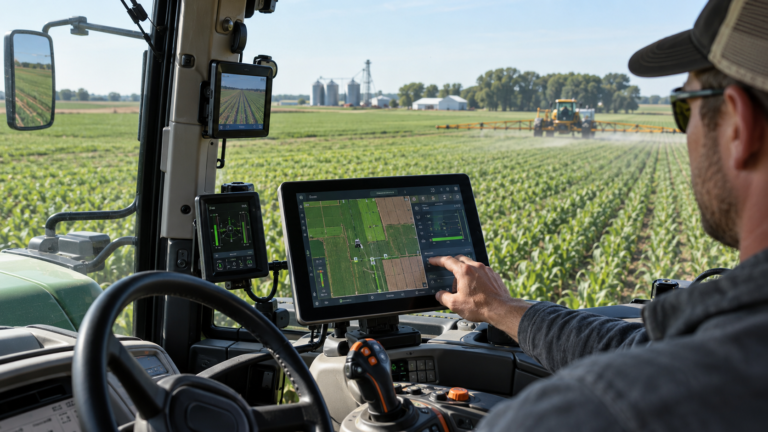
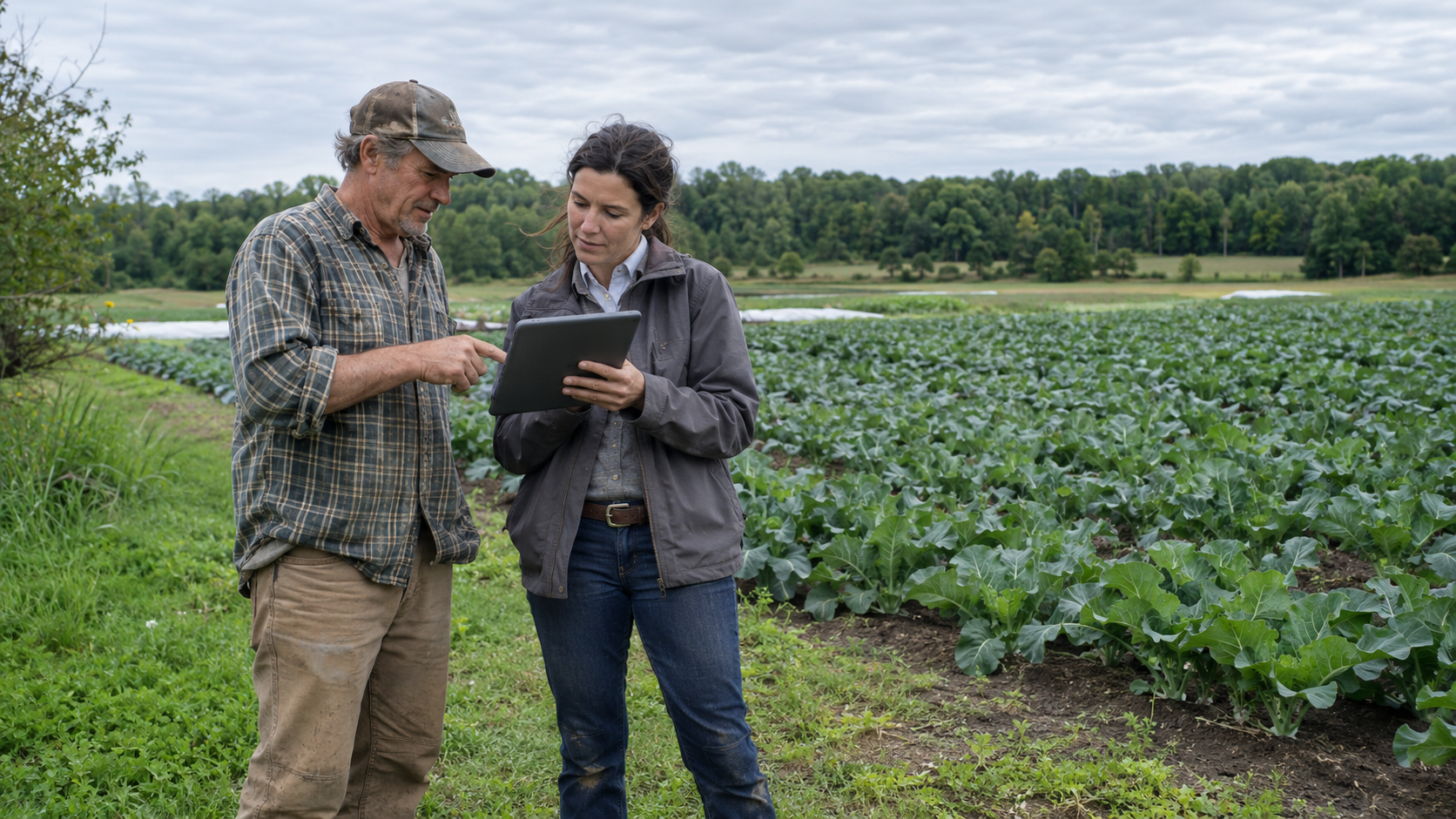
Imagine a farm manager receiving an AI-generated recommendation to irrigate a field. The dashboard suggests that the crop needs water, but a recent field inspection raises doubts. Before acting, the manager needs to understand which observations the system used, how recent they are, and whether its recommendation fits that field. This situation captures a practical challenge for AI in agriculture: deciding when an output deserves authority over a real operation.
The useful question is specific: can this tool support this decision under these conditions? An assistant organizing records, a model predicting disease risk, and a system controlling equipment require different kinds of scrutiny. Evaluating them together under a single label hides the evidence that matters most to the person responsible for the outcome.
Key Insight
Confidence in agricultural AI should match the evidence for the decision it supports. Evaluate it under relevant farm conditions, assign clear review responsibility, and expand its role as results justify greater reliance.
Trust in AI in Agriculture Starts With the Decision
A useful starting point is to identify what authority the proposed tool will have. Will it organize information for someone to review, recommend an intervention, or initiate an action? The same output can have different consequences depending on how it enters the workflow. An incorrect suggestion caught during planning creates a different problem from an instruction executed before anyone checks it.
Virginia Cooperative Extension’s guidance on generative AI recommends starting with tasks whose mistakes have limited consequences and verifying consequential advice with appropriate sources and expertise. It also cautions that fluent responses can contain errors or information unsuited to a particular farm. These observations concern generative tools; they do not establish the performance of a specialized agricultural model.[1]
For procurement discussions, separate the proposed use from the technology’s general capabilities. The comparison below illustrates how that changes the questions a buyer should ask.
| Illustrative use | What an error could mean | Evidence to request | Suggested review arrangement |
|---|---|---|---|
| Summarizing scouting notes | An observation is omitted or assigned to the wrong field | Comparison with the original records | Check the summary before using it to plan work |
| Flagging possible crop disease | A problem is missed or unnecessary investigation is triggered | Evaluation on relevant crops and image conditions, including missed cases | Confirm alerts through scouting and appropriate diagnostic support |
| Recommending irrigation timing | Water is applied at an unsuitable time | Testing relevant to the production system and checks on input quality | Review recommendations during a bounded pilot |
| Initiating equipment actions | A mistaken output becomes a physical operation | System-level testing and documented operating limits | Define supervision, stopping procedures, and fallback operation |
Illustrative examples; review arrangements should reflect the application and its consequences.
This approach makes the business conversation more precise. A supplier can explain which task has been evaluated, which conditions were represented, and where further testing is needed. The buyer can then decide whether the proposed role matches the available evidence rather than treating a successful demonstration as permission for every use.
High Test Accuracy Does Not Establish Local Reliability
Mohanty and colleagues’ 2016 plant-disease study showed both the promise of image classification and the challenge of transferring it to different conditions. It achieved 99.35% accuracy on a held-out PlantVillage test set. On two external online-image sets of 121 and 119 images, the best configurations achieved 31.40% and 31.69% across 38 crop-and-disease classes—well above the 2.63% random-guessing baseline.[2]
Defining the task differently changed the results. With the crop supplied, the published paper reports 47.8% accuracy for a restricted first-dataset evaluation covering nine crops with at least two classes each, compared with a 22.5% chance baseline. That is a more specific task on a restricted evaluation set, rather than a directly comparable improvement across all 121 images. These historical results demonstrate useful signal alongside a substantial transfer challenge; they do not describe today’s commercial products.[2]
For a buyer, the immediate question is where the evidence comes from. Ask whether testing used examples withheld from the training process and whether it included conditions relevant to the intended operation. For a disease-detection tool, that could mean the target crop, the symptoms of interest, and the kinds of images operators will actually capture. The request should be concrete enough for the supplier to answer with documentation.
Then examine errors, not just the headline score. In a scouting workflow, repeatedly flagging healthy plants creates extra inspection work, while overlooking a genuine problem could delay investigation. Ask the supplier to report both kinds of error and discuss which matters more for the planned use. An overall accuracy figure alone cannot settle that operational choice.
Farm data quality deserves the same attention. Return to the irrigation example: a sensible pilot would check whether the system receives current measurements, the correct field identifiers, and consistent units. Treat these as acceptance checks for the proposed implementation. Before debating the recommendation, establish that the information reaching the tool describes the situation the manager thinks it describes.
Explainable AI Helps Farmers Challenge Recommendations
An explanation is useful when it gives the operator something to investigate. In the irrigation example, a manager could ask which measurements contributed to the recommendation, what period they cover, and what important information is missing. A clear answer would help focus the review. A persuasive paragraph without those details would leave the operational question unresolved.
NIST’s AI Risk Management Framework treats explainability and validity as distinct aspects of trustworthy systems. Its guidance emphasizes evaluation for the intended use and recognizes that transparency alone does not establish trustworthiness.[3] Applied to agricultural decision support, that distinction means an understandable recommendation still needs relevant performance evidence.
Consider a hypothetical disease alert accompanied by an image highlighting a discolored area. That display could help an adviser inspect the symptom, but the display itself would not demonstrate that the diagnosis is correct. The practical follow-up is to ask what the system can distinguish, which similar conditions confuse it, and when it should defer to further investigation.
Keep this part of the assessment usable for the intended operator. A farm manager need not reproduce the model’s mathematics to ask whether its inputs are current or its operating limits are clear. The goal should be enough understanding to challenge an output and recognize when additional judgment is required. Documentation that cannot support those decisions has limited value during a busy working day.
Data Governance and Human Oversight Shape Trust
Trust also concerns the relationship around the tool. A 2026 systematic review of 38 publications identified data governance, technical skills, explainability, reliability, and cost as interconnected issues in agricultural AI adoption. This is a synthesis of a varied research literature, not a representative survey establishing how many farmers trust AI.[4]
That broader perspective matters when evaluating a service. A useful recommendation does not answer who may access the underlying records or what happens when the customer leaves. Research by University of Guelph authors discusses privacy, accountability, and robustness among the ethical concerns surrounding agricultural AI.[5] Buyers should bring these subjects into the discussion while they can still compare alternatives.
For the proposed implementation, ask the provider to explain data access, permitted reuse, retention, and export arrangements in plain language. Identify which information the tool needs for its task and which requested information is optional. Record unanswered questions before committing.
Human oversight needs similar specificity. “A person remains in control” is an incomplete operating plan unless someone knows what to review and when to intervene. In a pilot, name the reviewer, decide how disputed recommendations will be handled, and establish a fallback process. Include the people who will use the system, because an arrangement that works in a demonstration still needs to fit their actual responsibilities.
This also provides a useful connection to agricultural data interoperability. When evaluating connected tools, ask whether an adviser can inspect the records behind a recommendation and whether the farm can retrieve its history. Those questions connect technical integration to continuity of decision-making. They keep the discussion focused on the farm’s ability to understand and manage its operation as suppliers and tools change.
What to Ask Before Piloting an Agricultural AI Tool
A pilot should resolve a business uncertainty. “We want to use AI” is too broad to evaluate; “we want to determine whether this tool helps prioritize scouting without missing important cases” provides a clearer starting point. GreenEinsof recommends organizing the pilot around the following questions.
- Which decision are we improving? Specify the task, intended users, and the point at which the output enters an existing workflow. Exclude adjacent uses until they have their own justification.
- What evidence matches our conditions? Request relevant evaluation results and document the differences between the testing environment and the proposed deployment. Use the pilot to investigate those gaps.
- What will we compare it with? Establish a practical baseline, such as the current scouting process. Choose measures that reflect the intended benefit, including review time and important errors, rather than recording model accuracy alone.
- Who handles uncertainty and failure? Assign review responsibility and define how users can question, override, or suspend the tool. Agree on situations that require returning to the existing process.
- What is the full operational commitment? Include preparation, integration, staff training, supervision, and support alongside the subscription or equipment price. Track these during the trial instead of assuming that automation removes them.
- What evidence would justify continuing? Set acceptance and stopping criteria before assessing the outcome. Record unresolved limitations and define the conditions under which another evaluation will be needed.
The commercial value of this exercise is a clearer decision, including the possibility of narrowing the intended use. A tool that is useful for organizing observations might not yet have sufficient evidence to recommend treatment. Keeping those roles separate allows a business to capture a demonstrated benefit without extending reliance beyond what its evaluation supports.
Build Trust Through Evidence and Working Relationships
The next step for a farm considering AI is to choose one consequential question it can evaluate well. Bring the operator, adviser, and provider into that discussion early, then agree on what success and unacceptable failure would look like. Give the pilot enough structure to reveal weaknesses as well as benefits.
For technology providers, that creates an equally clear opportunity: make evidence, limitations, and support arrangements easy to examine. For farm businesses, it offers a basis for deciding where AI belongs in the operation. Trust can then develop around a specific, demonstrated contribution and a working relationship capable of responding when conditions change.
References
- Chandel, A., and Hota, S. (October 30, 2026). GenAI for Farms: Using AI Tools to Save Time, Find Reliable Information, and Make Informed Decisions. Virginia Cooperative Extension, BSE-398NP.
- Mohanty, S. P., Hughes, D. P., and Salathé, M. (2016). Using Deep Learning for Image-Based Plant Disease Detection. Frontiers in Plant Science. DOI: 10.3389/fpls.2016.01419.
- National Institute of Standards and Technology. (2023). AI Risk Management Framework 1.0 — AI Risks and Trustworthiness.
- Bhattarai, R., et al. (June 19, 2026). Scale, trust, and the digital divide: a systematic review of AI and ML for agricultural applications. Frontiers in Artificial Intelligence. DOI: 10.3389/frai.2026.1798896.
- Dara, R., Hazrati Fard, S. M., and Kaur, J. (July 29, 2022). Recommendations for ethical and responsible use of artificial intelligence in digital agriculture. Frontiers in Artificial Intelligence. DOI: 10.3389/frai.2022.884192.