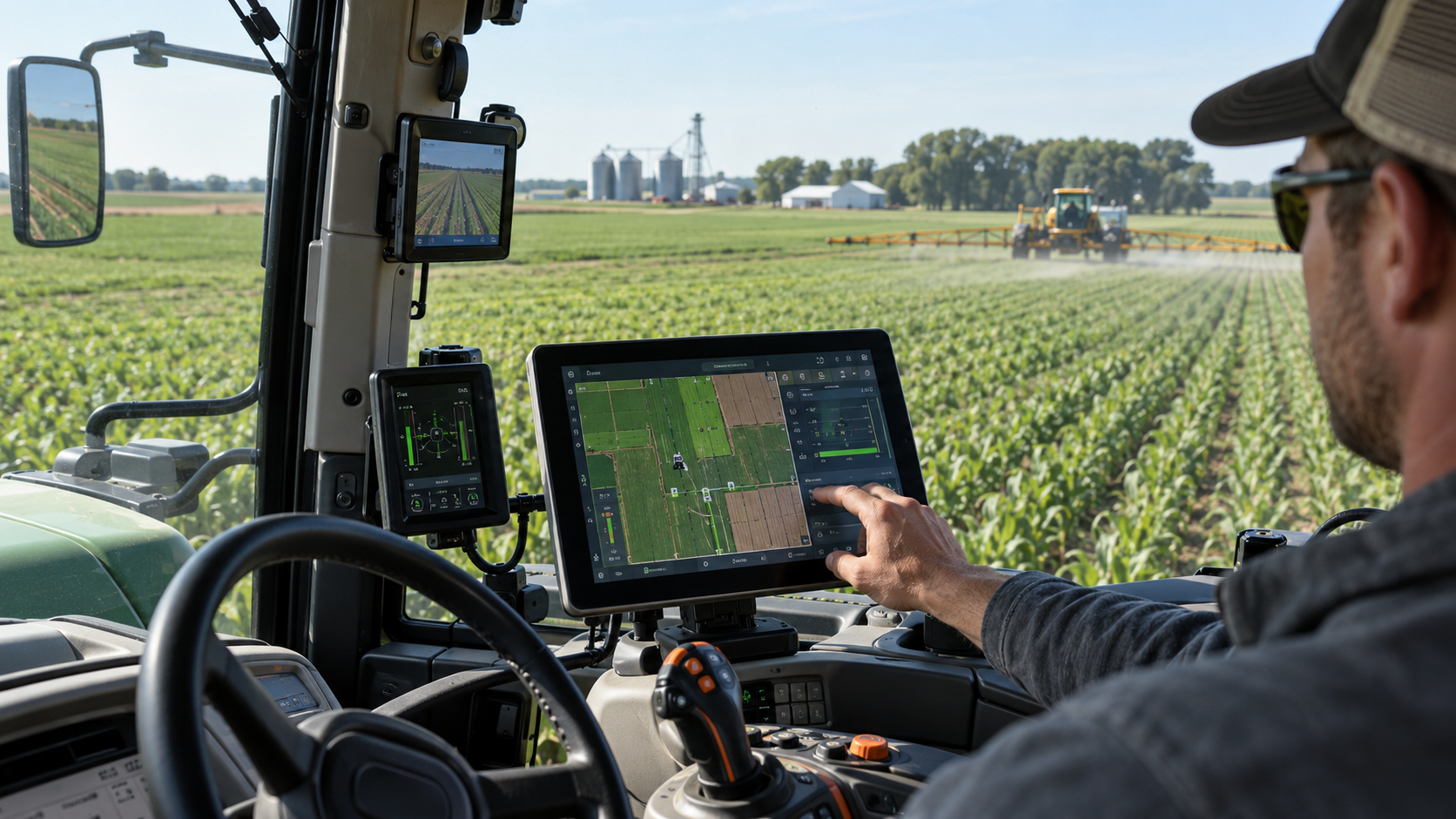
A farm can use GPS-guided equipment, soil sensors, crop imagery, and a sophisticated farm management platform—and still struggle to answer a straightforward question: how did a particular field operation affect the result at harvest? The problem is not necessarily a shortage of data. It is that essential information may sit in different systems, follow different definitions, or require manual work before it can be compared.
This is the agricultural data interoperability problem. As farms add digital tools, the ability of those tools to exchange and correctly interpret information becomes part of the value of every technology investment. For farm operators and agribusiness leaders, the strategic question is no longer just what an individual system can do. It is whether the farm can use information from several systems together.
Key Insight — Early Takeaway: Connecting more devices does not automatically create a connected farm. Interoperability depends on compatible technology, trustworthy and accessible data, and people who can manage the exchange. Before purchasing another platform, agricultural businesses should test how information will move into their existing workflows, who controls it, and what happens if the provider changes.
Why Agricultural Data Remains Fragmented
Agricultural information moves across a complicated operating environment. A planter records seeding operations, a sprayer documents applications, a weather service reports conditions, and a management platform stores field histories. Each is designed to solve a particular problem. The difficulty appears when users need a common picture of what happened, where it happened, and when.
A 2025 systematic review by Emmanuel Ahoa and colleagues at Wageningen University & Research examined 74 scientific papers on information-system integration in the agri-food sector. Of those, 46 discussed integration barriers. The researchers identified 27 distinct challenges, organized into three categories: 17 technological, five data-governance, and five organizational challenges [1]. These are categories identified in published research—not a ranking of what every farm experiences, or a survey of how common each problem is among farms.
Technological challenges: systems can exchange files without understanding them
The review’s 17 technological challenges include isolated applications, inconsistent system architectures, incompatible network specifications, weak communications infrastructure, poor data integrity, limited scalability, reliability problems, and processing delays [1]. Different machinery brands, sensor providers, and software developers may record similar activities in different structures. One application might accept a file yet interpret its field identifiers, units, or timestamps incorrectly.
Even a successful connection does not guarantee useful information. For example, a yield map may need calibration and cleaning before it can be compared meaningfully with application records. Basir and colleagues’ 2024 review of on-farm recordkeeping highlights the difficulties of obtaining complete, accurate, interoperable operational records across diverse tools [2]. In practical terms, moving a dataset is only the first test; preserving its meaning and quality is the harder one.
Data-governance challenges: access is also a business decision
The study identifies five data-governance challenges: security, lack of standardization, ownership, accessibility, and business privacy [1]. These concerns become more complicated when farm information passes between equipment suppliers, software providers, agronomists, service contractors, and buyers.
A provider may technically support data transfer, but its agreement may restrict what information can be retrieved, shared, retained, or reused. The farmer-oriented Ag Data Transparent principles therefore emphasize explicit consent, clear contracts, disclosure of data partners, portability, retention, and security [3]. These are voluntary industry principles, not a single law granting identical data rights in every jurisdiction. The practical lesson is to review contractual rights alongside technical compatibility.
Organizational challenges: integration requires a shared way of working
The review’s five organizational challenges concern differences among organizational data and systems, unclear business models, mismatched information needs, complex business processes, and insufficient skilled resources [1]. A farm manager, equipment operator, agronomist, and accounting team may all need information from the same field operation—but in different forms, at different times, and for different decisions.
Someone still has to define which field names are authoritative, who checks data quality, and which system records the final version of an operation. Without those agreements, adding an integration platform can move inconsistent information faster without resolving the underlying problem. Technology implementation is therefore partly a process-design and management task, not simply an IT installation.
What Poor Interoperability Means for Agricultural Businesses
The costs of fragmented information are often less visible than the purchase price of equipment or software. They appear as time spent exporting files, re-entering records, correcting mismatches, asking suppliers for help, or reconciling different reports. A system can be valuable on its own while still creating additional work whenever its outputs are needed elsewhere.
Consider an illustrative mixed-fleet crop operation. The seeding data sits in one manufacturer’s portal, application records in another, and yield information in a third system. To evaluate a season, the manager must first align field boundaries, dates, product names, and application units. If a contractor has used a separate platform, another set of records must be located. The bottleneck is not data collection; it is assembling reliable evidence for a decision. This scenario illustrates a workflow risk rather than a documented case or a quantified industry cost.
Fragmentation can affect decisions in three ways. First, it reduces timeliness. Information that requires extensive manual preparation may arrive after a useful management window. Second, it weakens comparability. Inconsistent units, missing metadata, or different field boundaries can distort comparisons between operations and seasons. Third, it increases dependence. If important records cannot be retrieved in a usable format, switching providers or integrating a new service can become expensive or impractical.
The U.S. Government Accountability Office’s 2024 assessment identified a lack of uniform standards as a barrier to precision-agriculture interoperability, alongside high initial costs and concerns about farm-data sharing and ownership [4]. It also highlighted the need for clearer ways to evaluate the benefits and costs of technologies. That does not provide a universal dollar estimate for the cost of poor interoperability. It does reinforce why compatibility, portability, and support requirements belong in procurement decisions.
| Integration barrier | Operational consequence | What to verify before investing |
|---|---|---|
| Proprietary or incompatible formats | Manual conversion and incomplete records | Can complete data be exported and imported into the target system? |
| Inconsistent field identifiers, units, or timestamps | Misleading comparisons across datasets | How are identifiers, units, and timestamps mapped and validated? |
| Unreliable connectivity or synchronization | Delayed or missing operational records | What works offline, and how does the system recover missed data? |
| Restricted access or unclear permissions | Dependence on a provider or difficulties changing services | Who can retrieve, share, and delete data, and under which contract terms? |
| Unclear responsibility for data quality | Persistent errors despite successful connections | Who owns corrections, monitoring, and support? |
Table note: This is a GreenEinsof decision framework derived from documented integration challenges [1–4], not an empirical ranking of costs or failure rates.
Can Agricultural Data Standards Solve the Problem?
Standards matter because they reduce the need for each company to invent a separate language for every connection. But different initiatives solve different parts of the problem. It is important to distinguish machine compatibility, data representation, and platform-to-platform exchange. A claim of “standards support” is too broad unless the supplier explains which workflows and functions have actually been tested.
ISOBUS and ISO-XML: connecting machinery and field operations
ISOBUS, based on the ISO 11783 family of standards, addresses communication among agricultural machinery and related systems. The Agricultural Industry Electronics Foundation (AEF) explains that real-world compatibility depends on which functionalities are supported by all components in a tractor–implement–terminal combination [5]. An ISOBUS label alone does not prove that every desired feature will work across mixed equipment. AEF’s certification and compatibility database help buyers evaluate particular functions and combinations [6].
ISO-XML is used in relevant ISOBUS task-controller workflows to transfer field-operation information between equipment and farm management systems [5]. That is useful, but it does not make every agricultural record interoperable. Farm finances, imagery, third-party sensor records, and other information may follow different systems and standards.
ADAPT Standard: improving the meaning and structure of production data
AgGateway’s ADAPT Standard addresses exchange of agricultural production data in consistent forms. Its official documentation describes version 2.0 and formats including JSON, GeoParquet, and GeoTIFF [7]. The standard specifies definitions and units intended to make transferred data more predictable for receiving systems. Importantly, the newer data standard is distinct from the earlier ADAPT Framework, a software toolkit used with plugins to interpret different formats.
This is a step toward both syntactic interoperability—systems agreeing on how information is structured—and semantic interoperability—systems agreeing on what that information means. Its practical benefit still depends on implementation by the software and equipment providers involved. A published standard cannot repair inaccurate source records or force a supplier to offer a particular integration.
APIs and AgIN: making connections manageable
An application programming interface, or API, allows software applications to request or exchange information through defined rules. APIs can support automated data flows, but an API is not automatically an open standard. Two connected services still need compatible definitions, permissions, and maintenance arrangements.
AEF’s Agricultural Interoperability Network (AgIN) takes a network-oriented approach to sharing machine data, work orders, and work records among equipment manufacturers, data hubs, and farm management systems [8]. It is designed to connect established platforms rather than replace them. AEF reported the start of a Common Connector integration phase in 2025 [9]. The initiative is promising, but support for particular providers and use cases should be checked directly; participation in a standards initiative is not proof that a farm’s entire workflow is already interoperable.
The lesson is not to choose one acronym over another. ISOBUS functionality, production-data standards, and cloud exchange mechanisms can complement one another, while organizational agreements and data quality remain necessary across them all.
Where Better Integration Can Create Practical Value
The most persuasive case for interoperability is not a single dashboard showing more data. It is a repeatable decision that becomes easier, more reliable, or better informed because several relevant datasets can be used together.
Take the question of whether a variable-rate application performed as intended. A useful assessment may require the prescription, the equipment’s as-applied record, field boundaries, product details, and subsequent crop observations. When those inputs can be aligned reliably, an agronomist can investigate differences between the planned and completed operation with less time devoted to preparing files. That does not establish a yield gain or a financial return by itself; the decision still depends on agronomic conditions and the quality of the data.
A second application is season-end reporting. Agricultural businesses may need to reconcile contractors’ records, chemical applications, input purchases, and harvested output. Better-integrated records could make the audit trail more complete and reduce duplicate entry. The benefit should be assessed against implementation effort, training, maintenance, and the possibility that some workflows will continue to require manual checks.
There is also a strategic dimension. Better data exchange can allow farms to evaluate specialized tools without rebuilding their information environment each time they change a provider. This flexibility matters as technologies evolve, but it should be demonstrated through real export-and-import tests rather than accepted from a marketing promise.
What to Check Before Buying Another Connected Farm Technology
A sensible interoperability strategy begins with a business decision, not a shopping list. Identify a recurring question that your organization cannot currently answer efficiently—such as reconciling application records with actual field operations—and work backward to the data and systems required.
For each proposed purchase or integration, ask:
- What decision will this connection improve? Define the person who needs the information, when they need it, and what better information would change.
- What data must move? Specify records, field boundaries, units, timestamps, metadata, and historical coverage rather than asking vaguely whether platforms “integrate.”
- Can we demonstrate the full workflow? Request a test using representative farm records, including errors and exceptions, from the source system through to the intended destination.
- Which standards and functions are actually supported? Ask for version numbers, supported use cases, certified equipment combinations where relevant, and known limitations.
- Who controls access and portability? Review consent, third-party sharing, export formats, retention periods, deletion rights, and what happens when the contract ends.
- What happens when connectivity fails or systems change? Examine offline operation, recovery, synchronization, version updates, security responsibilities, and ongoing support costs.
- Who will maintain data quality? Assign responsibility for naming conventions, field mapping, calibration, error resolution, and staff training.
A short pilot can expose more than a lengthy feature comparison. Start with one high-value workflow and representative data. Measure preparation time, missing or rejected records, correction effort, and whether the resulting information is genuinely usable. Only then consider extending the integration to more equipment, seasons, or partners. These are suggested evaluation measures, not published industry performance benchmarks.
Research Note: The literature identifies integration barriers and proposed solutions, but outcomes vary by crop, scale, technology mix, provider, and organizational capacity [1, 2]. Published standards and supplier initiatives demonstrate approaches to solving the problem, not guaranteed savings for any particular farm.
Conclusion: From Collecting Data to Making Better Decisions
Agricultural data interoperability is increasingly a question of operational design and commercial flexibility. Machinery compatibility is one layer. Consistent data definitions, accessible records, contractual rights, reliable infrastructure, and clear responsibility are others. An investment can satisfy one layer while leaving the entire decision workflow disconnected.
The strongest starting point for agricultural businesses is therefore practical: choose a decision worth improving, identify the information it requires, and make technology providers demonstrate that the data can travel, retain its meaning, and remain under appropriate control. Connected agriculture becomes valuable when information supports action—not merely when more systems are connected.
Explore This Topic Further
- Why Agricultural Equipment from Different Manufacturers Struggles to Share Data
- Who Owns Farm Data? Privacy, Control, and Portability
- Farm Connectivity Challenges: Why IoT Systems Fail in Rural Operations
- Why Agricultural Digital Transformation Fails Beyond the Technology
References
- Ahoa, E., Kassahun, A., Verdouw, C., & Tekinerdogan, B. (2025). “Challenges and Solution Directions for the Integration of Smart Information Systems in the Agri-Food Sector.” Sensors, 25(8), 2362. https://doi.org/10.3390/s25082362
- Basir, M. S., Buckmaster, D., Raturi, A., & Zhang, Y. (2024). “From Pen and Paper to Digital Precision: A Comprehensive Review of On-Farm Recordkeeping.” Precision Agriculture, 25, 2643–2682. https://doi.org/10.1007/s11119-024-10172-7
- Ag Data Transparent. “Core Principles” (updated 2024). https://www.agdatatransparent.com/principles
- U.S. Government Accountability Office. (2024, January 31). “Precision Agriculture: Benefits and Challenges for Technology Adoption and Use.” GAO-24-105962. https://www.gao.gov/products/gao-24-105962
- Agricultural Industry Electronics Foundation. “ISOBUS.” https://www.aef-online.org/about-us/isobus.html ; “AEF Tour: Functionalities.” https://www.aef-online.org/aef-tour/
- Agricultural Industry Electronics Foundation. “AEF ISOBUS Database.” https://www.aef-online.org/products/aef-isobus-database.html
- AgGateway. “ADAPT Standard — Overview and Version 2.0.” https://adaptstandard.org/
- Agricultural Industry Electronics Foundation. “Agricultural Interoperability Network (AgIN).” https://www.aef-online.org/aef-ag-in/
- Agricultural Industry Electronics Foundation. (2025, April 23). “AgIN Common Connector — Integration Phase.” https://www.aef-online.org/aef-news/agin-common-connector-integration-phase.html