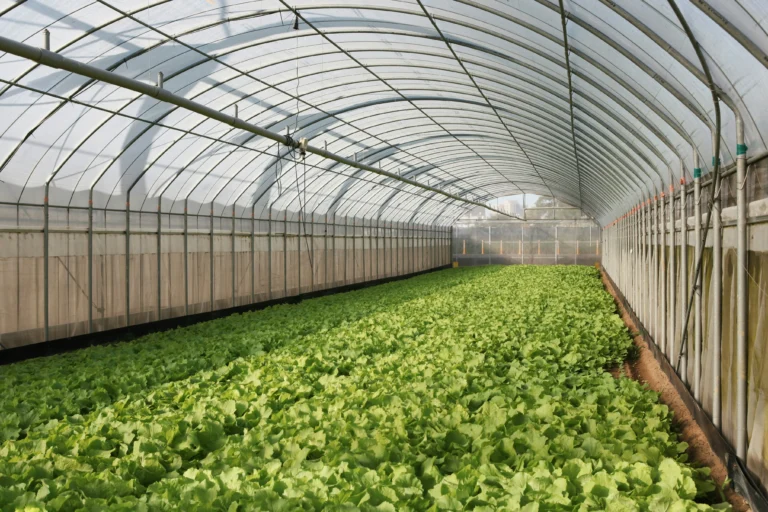
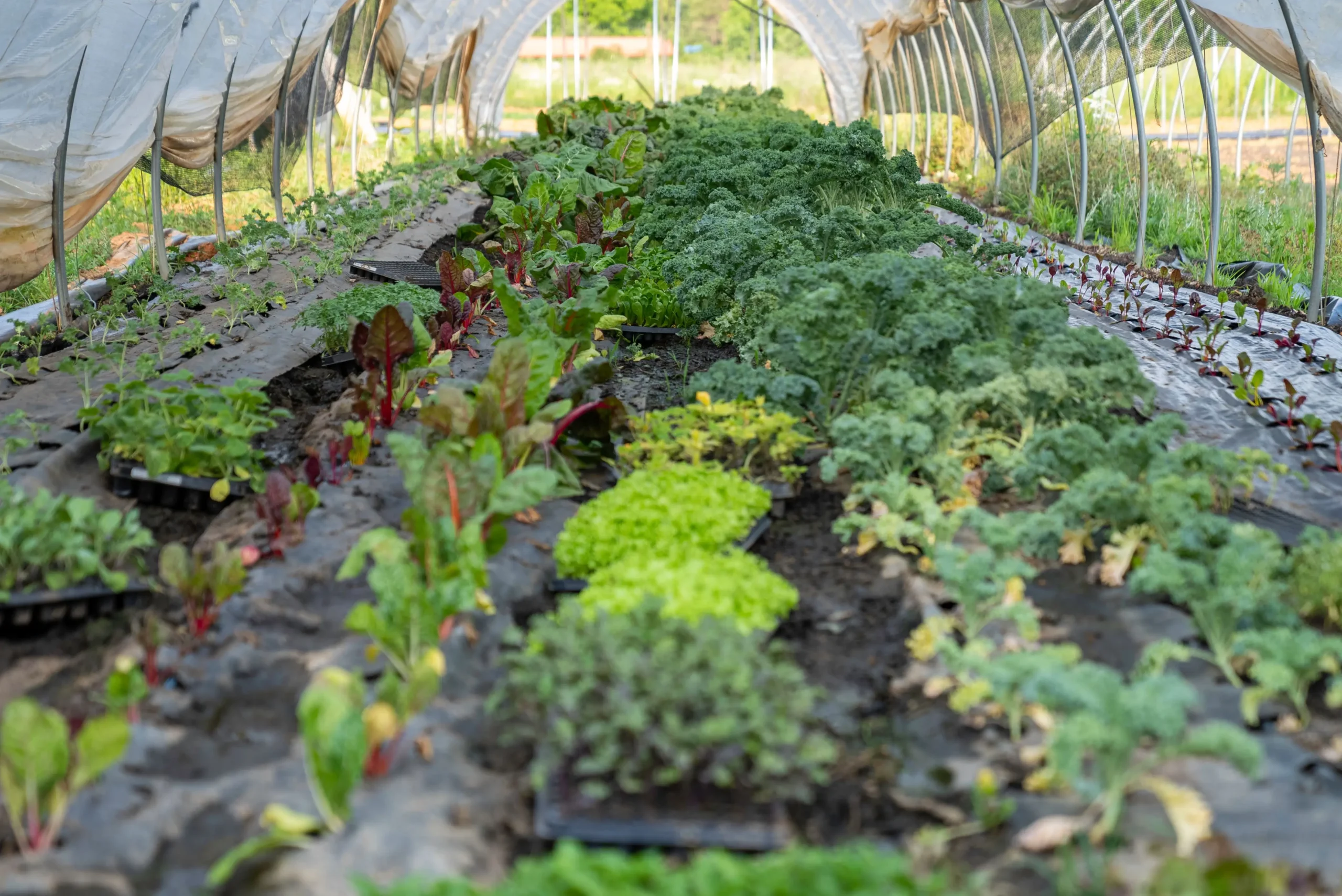
A greenhouse farm starts with a useful business proposition: protect the crop while using the daylight already available at the site. For an operator considering controlled environment agriculture, that can mean a different balance of investment, energy demand and production flexibility from a fully enclosed indoor farm. The opportunity becomes commercially meaningful when the structure fits the crop, the climate and the customer.
The case for greenhouse farming therefore deserves more than a list of benefits. Each advantage has conditions attached, and the technology is changing. Recent research is exploring more responsive crop controls and connections with surrounding energy systems, while official market data show the scale of protected food production. Together, these developments help explain why a greenhouse remains worth considering—and what to investigate before building one.
Key Insight: A useful greenhouse investment reduces a specific production constraint at a cost the crop can support. Before paying for more control, identify the customer requirement it serves, the operating expense it adds and the evidence needed to confirm its value.
What makes a greenhouse farm different?
A greenhouse uses a transparent or translucent covering to admit daylight, with equipment and management controlling conditions such as temperature, ventilation and irrigation. Designs vary substantially. A seasonal structure and an intensively heated, illuminated greenhouse should not be treated as equivalent investments. Hydroponics describes how plants receive water and nutrients; it can operate inside a greenhouse or an indoor facility. [1]
Here, the main comparison is with fully enclosed vertical farms that use artificial lighting and stacked growing areas. Container farms often belong within that indoor category rather than representing a completely separate growing method. The question is how much environmental independence the business needs and what it costs to provide it. Our broader CEA pillar article provides the background to these production choices.
Six reasons to consider greenhouse farming
1. A lower initial investment can leave more room to establish the business
Greenhouses can avoid part of the building, lighting and multilayer infrastructure required by fully enclosed vertical farms. USDA’s 2024 review identifies substantial startup costs across CEA and cites higher illustrative construction costs for vertical farms than greenhouses. Those historical estimates describe a broad investment pattern, not a current quotation for a particular site. [2]
For a new greenhouse farm, the practical benefit is the possibility of retaining capital for the first production cycles. Construction is only one demand on cash. Crop establishment, staff, packaging, customer development and the period before reliable sales also need funding. A proposal that spends nearly everything on equipment leaves little room to correct early production or marketing problems.
Request a complete project budget before comparing suppliers. Separate the structure from site works, utility connections, growing equipment, packing space and operating reserves. Ask whether area-based prices refer to the building footprint or usable crop area. The cheapest shell is not necessarily the lowest-cost route to consistent saleable produce.
2. Daylight can reduce the energy purchased for production
The energy advantage of a greenhouse farm begins with sunlight. Graamans and colleagues compared modeled lettuce production across several climates and found that greenhouses required less purchased energy than plant factories in the assessed cases. The study also showed why total resource efficiency and purchased energy are different measures: sunlight contributes energy without appearing on an electricity bill. [3]
That benefit needs a seasonal operating plan. Winter heating, summer cooling and supplemental lighting can materially change greenhouse operating costs. Compare the months when the crop earns its revenue with the months when maintaining production becomes most demanding. An annual average can conceal a difficult winter business case.
Established equipment can help. UMass Extension describes how energy screens reduce heat loss and identifies installation choices that affect their suitability. Its guidance supports considering screens during design, rather than assuming any retrofit will fit the structure. [4] The investment question is whether an improvement lowers the cost of marketable output while preserving the crop conditions the business requires.
3. Established technology offers a foundation for selective automation
Greenhouse farming combines familiar production equipment with a wide range of control options. Virginia Cooperative Extension describes ventilation, irrigation, lighting, sensors and climate systems used across CEA. That range allows operators to consider technology around a defined production task rather than treating maximum automation as the starting point. [1]
New research is making that choice more interesting. In November 2026, Wageningen University & Research described GreenControl, a project investigating how plant measurements can guide greenhouse operation. Its objectives include 25% lower energy use and 35% lower energy costs. These are research targets, not demonstrated savings available to every grower. The project also highlights practical difficulties: sensors can become dirty or inaccurate, and measurements must lead to understandable control decisions. [5]
For a greenhouse farm, this suggests a disciplined approach to upgrades. Identify who checks sensor quality, how alarms reach staff and what happens if a controller or connection fails. Ask whether a lighting system can exchange useful information with climate and irrigation controls. A supported, maintainable system offers more operational value than features the team cannot reliably use.
4. Lower emissions are achievable when the energy system supports them
Using daylight can contribute to a smaller production footprint, but the result must be assessed across the farm’s energy and material inputs. Blom and colleagues’ 2022 Dutch lettuce study compared an operating vertical farm with greenhouse and open-field systems. The vertical farm had higher life-cycle emissions in the assessed scenarios, with electricity accounting for 85% of its baseline footprint. This is evidence from a particular comparison, not a universal greenhouse-versus-indoor emissions ratio. [6]
A greenhouse farm should therefore assess its actual heating fuel, electricity supply, crop losses and saleable output before making environmental claims. The meaningful business question is what changes emissions per unit sold. Reducing an energy bill by buying cheaper fuel, for example, is not evidence that emissions have fallen.
The comparison should also preserve the service being delivered. Producing a crop in a different season or to a different specification changes the question. For procurement discussions, request an explanation of the assessment boundary and energy assumptions rather than accepting a sustainability label as proof.
5. Greenhouse energy systems can connect with local resources
A greenhouse’s heating requirement creates opportunities to investigate local heat supplies alongside renewable electricity. WUR’s September 2026 Greenhouse in Transition update describes research into exchanging water and waste heat with surrounding farms and industrial sites. The project treats the greenhouse as part of a wider resource system, with research extending beyond the building itself. [7]
For a proposed greenhouse farm, potential options to assess include heat pumps, nearby recovered heat and renewable electricity. Their suitability depends on engineering and supply conditions. An inexpensive heat source is only useful if it can deliver the temperature, quantity and reliability required during the growing season. Distribution infrastructure and backup arrangements belong in the project budget.
This creates a useful site-selection question: what resources are available nearby, and on what terms? A potential partner’s proximity should trigger technical assessment and a supply discussion. It should not be counted as a secured saving before capacity, availability and costs are established. The opportunity is real; its value remains site-specific.
6. Established crop markets can support a clearer commercial proposal
Greenhouse farming has an established place in food production. USDA’s horticultural census, released in February 2026, reports $1.01 billion in U.S. sales of food crops grown under protection in 2024, up 44% from 2019. This is a defined statistical category covering protected production, not greenhouse-only profit or proof of unmet local demand. [8]
Crop choice still matters. Farm Credit Canada’s 2025 assessment identifies tomatoes, cucumbers and peppers as significant greenhouse contributors to Canadian food supply, while emphasizing high investment requirements and limits to suitable crops. [9] A greenhouse offers options, but a wider theoretical crop list does not mean every crop fits the same equipment, labor plan or customer.
The financing advantage is best understood as an opportunity to make the proposal more concrete. A greenhouse farm can present a specified crop, credible production assumptions, prospective buyers and equipment quotations for review. Whether those elements secure funding depends on the project and the lender; there is no verified universal financing advantage simply from choosing a greenhouse. Build the business case around documented demand and realistic operating performance.
When a greenhouse farm is the wrong choice
A greenhouse becomes a poor fit when the cost of meeting the production target overwhelms what buyers will pay. Limited winter daylight, costly heat, difficult cooling conditions or inadequate utilities can undermine the expected advantage. Equally, a suitable growing environment cannot solve a weak route to market. These are reasons to reassess the crop, season, location or scale before committing capital.
Indoor alternatives deserve a fair assessment when they address constraints the proposed greenhouse cannot economically resolve. However, future technology improvements should not be treated as existing performance. A 2026 modeling study examining lettuce and tomatoes against Dutch greenhouse cost benchmarks explicitly frames its advanced scenarios as crop-performance targets, rather than predictions of realized commercial outcomes. [10]
Use the following questions to identify what still needs evidence. This is a GreenEinsof planning checklist, not a scoring model or investment forecast.
| Decision area | Evidence to request before committing |
|---|---|
| Customer fit | Buyer specifications, realistic net prices and delivery requirements |
| Site suitability | Seasonal climate assessment, water analysis and utility capacity |
| Production design | Crop-specific output assumptions and a clear definition of marketable yield |
| Operating capability | Staffing plan, service arrangements, monitoring and backup procedures |
| Financial resilience | Complete project budget and scenarios for slower sales, higher costs and crop losses |
How to plan a greenhouse farm in seven steps
- Define the customer requirement. Establish the crop, grade, packaging, volume and delivery schedule the customer wants. Record which assumptions are confirmed and which remain exploratory.
- Choose crops around commercial and production fit. Test the proposed selling price against expected quality, labor requirements and losses. Avoid treating a crop’s popularity as evidence of local demand.
- Match the structure to the production season. Specify the level of protection and climate control needed. Compare a longer season with year-round operation before assuming both require the same investment.
- Validate the site and essential services. Obtain relevant local assessments of water, energy, access, structural requirements and permissions. Resolve expensive infrastructure questions before final equipment selection.
- Prepare a complete operating model. Include labor, energy, inputs, packaging, delivery, maintenance and financing. Examine the effect of delayed startup and lower saleable output as well as the expected case.
- Build the operating team early. Assign responsibility for crop management, equipment, food-safety procedures and sales. Arrange training and escalation support around the actual systems selected.
- Stage spending around evidence. Where practical, use trials or a smaller initial phase to test crop performance and customer acceptance. Match expansion to demonstrated capability and review funding requirements with suitable advisers.
A practical next step
Before requesting another greenhouse quotation, prepare a short statement of the production problem: what crop needs to be supplied, to whom, in which months and at what specification. That statement gives growers, technology providers and business advisers a shared basis for evaluating options. GreenEinsof’s perspective is to connect those operational requirements with technology choices and usable evidence, so the eventual design serves a clearly defined business.
Frequently asked questions
Can a greenhouse farm be profitable?
It can, but profitability is a project result. Assess the price actually received after selling and distribution costs, the quantity that meets buyer specifications and the full cost of delivering it. Industry sales growth cannot substitute for that calculation.
What should greenhouse startup costs include?
Include the site, structure, services, growing systems and facilities needed to handle the crop after harvest. Add professional assessments, commissioning and operating reserves. Obtain current local quotations; historical per-area estimates are unsuitable as a complete construction budget.
Is greenhouse farming preferable to vertical farming?
Daylight can give greenhouse production a purchased-energy advantage, while fully enclosed systems offer different environmental and space-control options. Compare the same crop, location and customer requirement before selecting a model. [1,3]
Which crops should a new greenhouse farm grow?
Begin with buyers and the proposed growing conditions. Tomatoes, cucumbers, peppers, leafy greens and herbs are candidates to investigate, not a universal shortlist of profitable crops. Confirm the production method and market requirements for each candidate before investing. [1,9]
References
- Virginia Cooperative Extension. What is Controlled Environment Agriculture? SPES-751NP.
- Dohlman et al., USDA Economic Research Service. Trends, Insights, and Future Prospects for Production in Controlled Environment Agriculture and Agrivoltaics Systems. January 11, 2024. EIB-264. Full report.
- Graamans et al. Plant factories versus greenhouses: Comparison of resource use efficiency. Agricultural Systems 160, 31–43 (2018 issue; repository records 2017). DOI.
- UMass Amherst Extension. Selecting an Energy/Shade Screen System.
- Wageningen University & Research. Growing crops based on what plants need. November 4, 2026.
- Blom, Jenkins, Pulselli and van den Dobbelsteen. The embodied carbon emissions of lettuce production in vertical farming, greenhouse horticulture, and open-field farming in the Netherlands. Journal of Cleaner Production 377, 134443 (2022). DOI.
- Wageningen University & Research. The greenhouse of the future grows with its surroundings. September 9, 2026.
- USDA NASS. U.S. Horticulture Operations Report $18.3 Billion in Sales. February 26, 2026.
- Farm Credit Canada. Canada sees rising interest in controlled environment agriculture. May 28, 2025.
- Meeuws et al. Vertical farming economics: crop performance targets for cost-competitive vertical farming. Frontiers in Sustainable Food Systems, July 8, 2026.