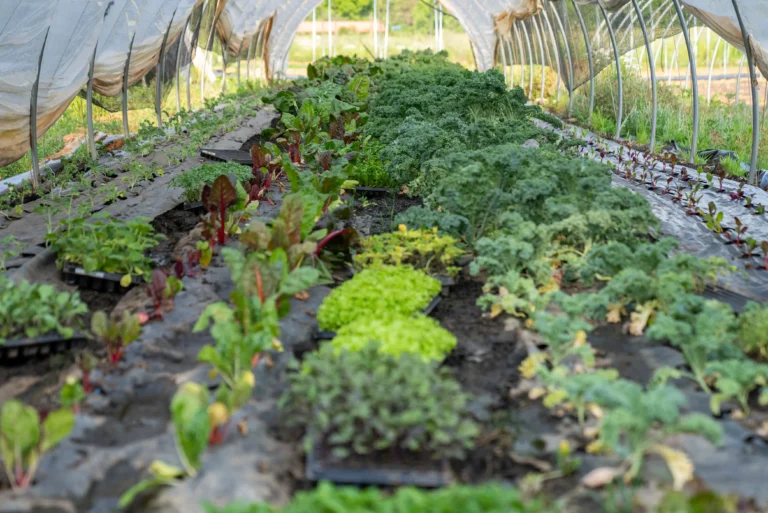
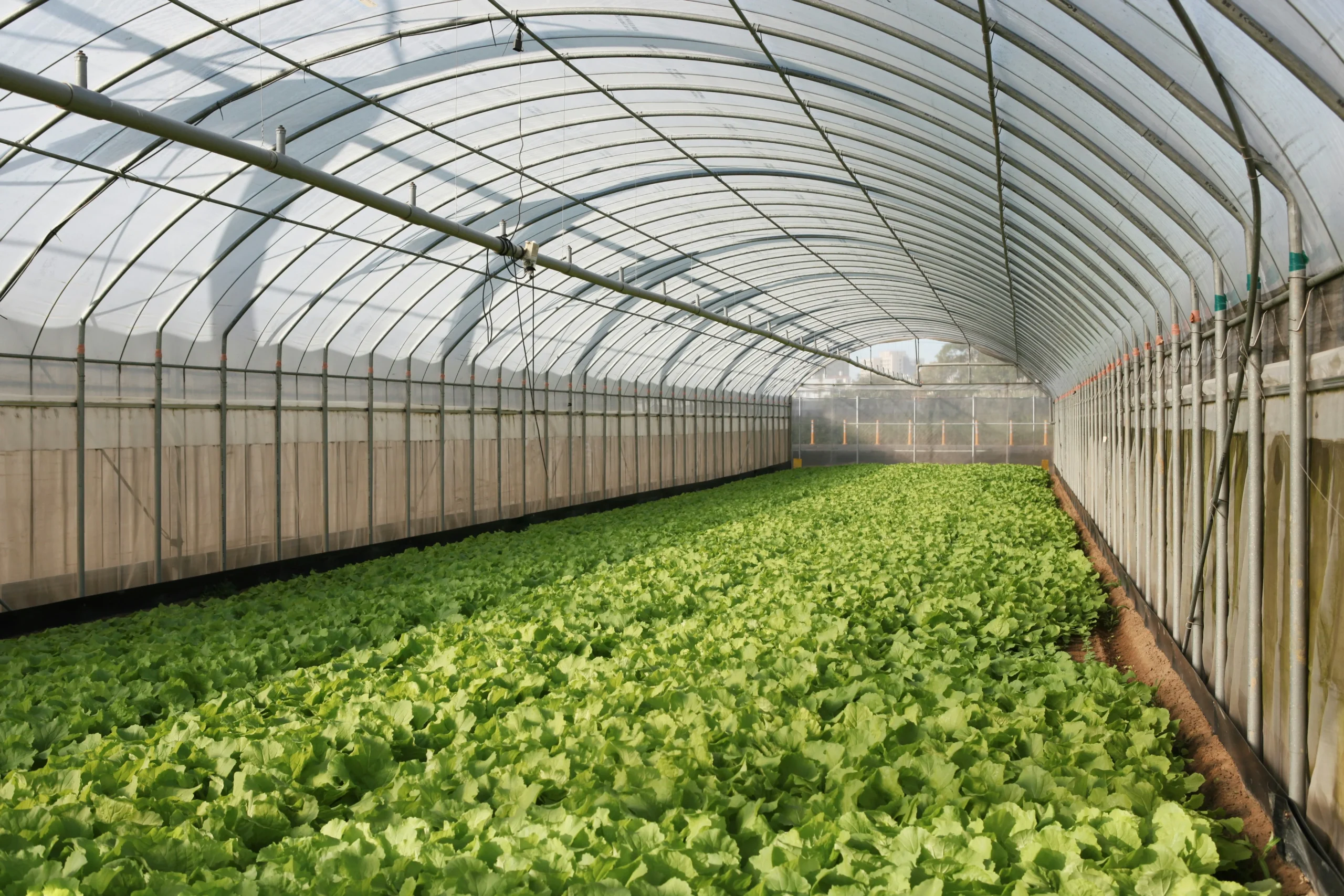
Controlled environment agriculture (CEA) is the production of crops in growing structures where farmers manage some combination of light, temperature, humidity, water, nutrients, and other environmental conditions. It includes high tunnels, commercial greenhouses, and fully enclosed indoor farms. The level of control varies widely; CEA does not automatically mean hydroponics or vertical farming. [1][2]
Growing more food does not always require more farmland. Sometimes the opportunity is to lengthen a growing season, protect a high-value crop, or deliver a predictable harvest to a committed buyer. A relatively simple high tunnel might be sufficient. At the other extreme, a fully enclosed farm can engineer most of the crop’s growing environment—but must also pay to operate that environment.
This distinction is central to the future of controlled environment agriculture. The sector includes profitable, established forms of protected cultivation alongside highly capitalized indoor-farming ventures that have struggled or restructured. The relevant question is not how advanced the equipment is. It is whether added environmental control creates enough marketable crop value to cover its full cost.
Key Insight
Control is an investment, not an agricultural outcome. The strongest CEA project is the one that matches the crop, climate, buyer requirements, and operating economics—not necessarily the most technologically advanced design.
What Counts as Controlled Environment Agriculture?
CEA describes the environment in which a crop is produced, not one particular nutrient-delivery technology. A greenhouse can use soil or soilless substrates. Hydroponic farming provides dissolved nutrients to roots through water, sometimes with an inert substrate; aeroponics applies nutrient solution as a mist. Neither method inherently requires crops to be stacked vertically. Likewise, a vertical farm may use hydroponic or aeroponic systems. [1][2]
Greenhouse vs. vertical farm vs. high tunnel
| System | Typical lighting | Environmental control | Suitable applications | Main trade-off |
|---|---|---|---|---|
| High tunnel / hoop house | Sunlight | Mostly passive season and weather protection | Seasonal vegetables, berries, specialty crops | Limited precise control; weather still matters |
| Commercial greenhouse | Sunlight; optional supplemental LEDs | Heating, ventilation, shading, irrigation and climate controls to varying degrees | Tomatoes, cucumbers, lettuce, herbs, transplants, ornamentals | Infrastructure, heating or cooling, labor and management |
| Enclosed indoor / vertical farm | Primarily artificial lighting | Engineered light, air, humidity, irrigation and nutrient delivery | Often leafy greens, herbs, microgreens and propagation; selected fruit crops | Electricity, capital costs, reliability and market pricing |
These are broad operational descriptions, not universal specifications. The growing method (for example, hydroponics) is a separate design choice. Sources: University of Georgia Extension and Virginia Cooperative Extension. [1][2]
A high tunnel is not an inferior version of a vertical farm. In a sunny region, a lower-tech structure may solve a meaningful production problem for a fraction of the operating complexity. Conversely, an enclosed farm can be commercially attractive when space, crop quality, climate constraints, or contracted supply requirements make its additional control valuable.
Hydroponics vs. aeroponics: what actually changes?
Both hydroponics and aeroponics fall within soilless cultivation. In hydroponics, the nutrient solution reaches roots through flowing or standing water or through irrigated growing media. In aeroponics, roots are suspended and regularly exposed to a nutrient mist. Pumps, distribution equipment, monitoring, and the consequences of interrupted delivery differ between designs. Neither system is automatically more profitable or water-efficient without knowing the particular crop and operating conditions. [1][2]
CEA Benefits: Where Environmental Control Creates Value
The commercial case for controlled environment agriculture usually begins with a constraint: too short a season, unstable quality, difficult weather, unreliable supply, land limitations, or a specific customer requirement. Rather than making broad promises about year-round local food, operators need to identify which constraint the proposed facility actually resolves.
A greenhouse may help a grower harvest outside the normal field season, manage rainfall and wind exposure, and regulate crop conditions more consistently. An enclosed indoor farm can be less dependent on seasonal sunlight, but it must generate light and handle the resulting energy and climate-control requirements. Either model still needs customers who will buy the crop at a viable price. [1][2]
Crop choice is more important than technology appeal
Leafy greens, herbs and microgreens are commonly discussed in vertical-farming projects because they can suit short growth cycles and compact production layouts. Greenhouse tomatoes and cucumbers may involve taller plants, different harvest schedules, greater labor needs and different lighting and heating requirements. The farm should therefore be assessed on saleable yield and net economic return, not just biological yield or kilograms produced per square meter. [1][2]
The 2024 U.S. Census of Horticultural Specialties illustrates why crop economics deserve closer attention. Of approximately $1.011 billion in reported sales of food crops grown under protection, tomatoes contributed $383.0 million and lettuce $238.3 million—together about 61.4% of this category’s sales. The same table reports more than 3.44 million hundredweight of hydroponic production, approximately 59.6% of its total reported production weight. These are measured national totals, not a profitability survey. [3]
One useful descriptive comparison is reported annual sales per square foot of crop-specific protected area, calculated directly from the USDA table:
Source: USDA NASS 2024 national Table 15. Arithmetic: value of sales divided by crop-specific area under protection. These are aggregate reported sales densities, not profit, annualized returns on invested capital, per-harvest comparisons, or controlled comparisons of otherwise equivalent facilities. Crop cycles, prices, area reporting and production practices differ. [3]
This chart is not evidence that microgreens are universally a better investment than tomatoes. It shows how dramatically crop mix and production model can change the revenue picture—and why a grower cannot borrow another crop’s business assumptions.
U.S. CEA Statistics: Operations Up, Output Down, Sales Up
USDA’s historical analysis shows that U.S. protected food-crop operations increased from 1,476 in 2009 to 2,994 in 2019, while reported crop output rose 56% over that decade to nearly 7.86 million hundredweight. [4]
The newer 2024 Census of Horticultural Specialties makes it possible to compare the specific Food Crops Grown Under Protection and Sold category with the corresponding 2019 census table. This direct comparison corrects an excessively cautious note in the earlier GreenEinsof draft. [3][5]
Sources: USDA NASS 2019 Table 15 and 2024 Table 15. Percentage changes independently calculated from published totals. A U.S. hundredweight equals 100 pounds. Sales figures are nominal and have not been adjusted for inflation. [3][5]
What explains the apparent contradiction? The tables establish that reported production weight fell while sales dollars rose. They do not, by themselves, prove why. A simple descriptive calculation puts reported sales per hundredweight at approximately $89.54 in 2019 and $175.11 in 2024—but that ratio reflects aggregate revenue and weight across different crops, not a like-for-like market price or a producer margin. The 2024 census also distinguishes some crop categories, including microgreens and spinach, that were not separately itemized in the 2019 national table. Crop composition, reporting details and price changes must be investigated before assigning causation. [3][5]
The data gives a more nuanced picture than an uncomplicated growth narrative. The number of operations grew, revenue grew in current dollars, aggregate reported weight fell, and measured area changed very little. The census is also not a measure of the full CEA economy: it does not represent equipment sales, consulting, all nursery production, or an industry-wide profit figure. Although the 2024 horticultural census added separate categories for cultivated mushrooms and hemp, those are not part of the Table 15 food-crop total. [3][5]
Why Vertical Farming Bankruptcies Matter to CEA Profitability
Recent company histories provide a necessary counterweight to market-growth statistics. Bowery Farming ceased operations in November 2024, according to industry reporting and U.S. state closure notices. AppHarvest, a greenhouse-focused company, entered Chapter 11 in July 2023 and subsequently pursued liquidation through a court-confirmed plan. These examples represent different business models and should not be treated as proof that all controlled environment agriculture has the same economics. [10][11]
Other companies illustrate a different outcome: AeroFarms entered Chapter 11 in June 2023 and announced its emergence in September 2023. Plenty filed in March 2025, then announced that it had emerged from Chapter 11 in May 2025 with a narrower emphasis on premium strawberries. Filing for bankruptcy protection, liquidating, and restructuring successfully are distinct outcomes. [12][13][14]
The broader lesson is not that vertical farming cannot work. It is that raising capital, demonstrating production technology, and operating a self-sustaining food business are separate milestones. Investors and growers need to examine financing, production cost per marketable kilogram, labor, electricity, contracts, price realization, and the cost of expanding facilities. A large crop yield does not guarantee positive cash flow.
A contrasting operating example: Lufa Farms
Canadian operator Lufa Farms reports multiple rooftop greenhouses around Montréal as well as a separate indoor farm. Its 2024 Marché Central greenhouse is described as approximately 127,000 square feet; the operator also describes using LEDs, insulated glazing and curtains. These are operator-reported facility details—not independently audited evidence of profitability or sustainability. They nonetheless show that actual CEA development can combine rooftop greenhouses, hydroponics and indoor cultivation rather than fitting one single template. [15]
Greenhouse Climate Control: DLI, VPD and Nutrient Management
CEA works through the interaction of environmental variables. A lighting upgrade affects more than light; it also affects power requirements and potentially heat management. Changes in ventilation and humidity can influence transpiration and irrigation needs. Effective greenhouse climate control therefore connects crop physiology to equipment decisions rather than independently optimizing each device. [1][2]
Practical DLI ranges for leafy greens and vine crops
Daily light integral (DLI) measures the photosynthetically useful light received by a crop over a day. Virginia Cooperative Extension provides general reference ranges of 12–17 mol/m²/day for lettuce, 15–25 for basil, and 20–30 for tomatoes or cucumbers. These are planning ranges, not universal prescriptions: cultivar, growth stage, temperature, facility design and production goal all matter. [6]
The University of Georgia also discusses roughly 12–17 mol/m²/day for leafy greens and about 25–30 or more for vine crops. The two publications broadly agree that fruiting crops often require more light than leafy greens, while their illustrative ranges differ slightly. The commercial decision is whether the yield or quality gain from supplemental LEDs is worth the added energy, heat-management and capital expense. [1][6]
Vapor pressure deficit (VPD) describes the air’s drying demand and helps interpret plant transpiration. University of Georgia Extension discusses concerns below approximately 0.4 kPa and above approximately 1.0 kPa in its introductory treatment. Those boundaries should not be turned into a universal set point: the appropriate operating range depends on the crop, leaf and air conditions, and production stage. [1]
Hydroponic fertigation and water reuse
Hydroponic systems make it possible to manage fertilizer delivery through nutrient solution, with electrical conductivity (EC), pH, water quality and dissolved oxygen among the variables requiring attention. Recirculation can reduce water or nutrient discharge, but it requires monitoring, sanitation and occasional correction or treatment of the solution. Aeroponic mist delivery brings different equipment and interruption risks. Protection from outdoor pests also does not eliminate plant disease or the need for integrated pest management. [1][2]
CEA Energy Costs and the Sustainability Trade-Off
The environmental case for CEA cannot be made from water savings or floor-area yield alone. Energy demand is often decisive, particularly in tightly controlled indoor facilities, and results change with electricity supply, crop and local climate.
A 2025 peer-reviewed synthesis by Evan Mills examined 116 studies across different facility types and crop settings. It found very wide variation in energy use per unit of harvest; in the reviewed studies, reported median energy intensity was 27 MJ/kg for greenhouses and 127 MJ/kg for plant factories. These are literature medians across unlike facilities and crops, not energy forecasts for a specific proposed project. [7]
For a more concrete crop comparison, a 2025 life-cycle study by Gargaro and colleagues assessed a commercial vertical lettuce farm and field farms in the UK and Spain. In the study’s scenarios, vertical-farm lettuce produced using the then-current UK electricity mix had an estimated 4.71 kg CO₂e per kilogram of lettuce, compared with approximately 0.55–0.59 kg CO₂e/kg for several UK field scenarios. With an assumed renewable electricity supply, the vertical-farm result decreased to 0.93 kg CO₂e/kg—a major improvement, but still above those UK field scenarios. These are modeled life-cycle results for the studied systems, not universal emission factors. [8]
The same paper reported 97.3 kg/m² of production for the vertically farmed lettuce scenario, versus 3.3 kg/m² averaged across its field-farm scenarios. That is a substantial production-density advantage, but it should not be equated with lower life-cycle land-use impact. The land-use result was unusually sensitive to the assumed jute growing plugs; substituting coconut coir in a model scenario lowered the estimated land-use impact sharply. The paper also reports a water-deprivation impact indicator, which is not directly interchangeable with liters of irrigation water used. [8]
A separate 2025 lettuce assessment by Banboukian, Chen and Thomas likewise found that a modeled, highly controlled hydroponic system could use land and water more efficiently than alternative systems while carrying higher electricity-related climate impacts. Its lower-energy protected growing scenario performed well in several environmental comparisons. The findings are study-dependent and should not be applied to all crops, regions or electricity grids. [9]
These studies create a practical decision framework: evaluate greenhouse heating and cooling loads, the local energy mix, lighting schedule, actual water stress, growing-medium supply, and marketable crop output together. Sustainability is a whole-system result, not an attribute bestowed by a technology label.
Greenhouse Automation and AI: Integration Before Sophistication
A commercial CEA facility may combine climate sensors, programmable heating and ventilation, supplemental lighting, irrigation controls, fertigation, imaging systems, and crop-monitoring software. Those systems are useful only when they support timely, reliable decisions and maintainable operations. [1]
Consider an illustrative example, not a documented farm case: an operator adds evening LED lighting to reach the crop’s DLI target. Power demand rises; air temperature and humidity may shift; irrigation timing may need adjustment. If lighting, climate and nutrient controls are managed as disconnected systems, optimizing one target can create new costs or stress elsewhere. Greenhouse automation is more valuable when accurate measurements, clear goals and human oversight connect the decisions.
AI may assist in forecasting or recognizing patterns in farm data, but it cannot replace agronomic validation, good sensors, a contingency plan, or an economically justified business model. For GreenEinsof’s wider agricultural technology coverage, the important connection is data interoperability: whether different systems can share usable information, rather than merely generate more readings. See GreenEinsof’s agricultural data interoperability article.
Five Critical Questions Before Investing in Controlled Environment Agriculture
- Who will buy the crop, at what grade, volume, price and delivery frequency? Confirm the market assumptions before designing a facility.
- What problem does greater environmental control solve? Identify a measurable constraint: weather exposure, season length, quality consistency, food-safety practices, or production reliability.
- What is the least complex system that meets that need? Compare high tunnels, greenhouses and indoor farms against the same commercial objective.
- Do the full economics hold under unfavorable conditions? Include energy costs, labor, packaging, losses, financing, maintenance, downtime and the price needed to cover them.
- Can the operation run and maintain the system reliably? Assess skills, backup power, disease management, vendor support, monitoring quality and the consequences of equipment failure.
A smaller protected-crop pilot, a stronger purchasing agreement, or a more accurate energy model may be a better first investment than the most sophisticated installation. CEA feasibility is ultimately a question about a particular crop and place—not a verdict on a technology category.
Conclusion: When Controlled Environment Agriculture Makes Sense
Controlled environment agriculture offers several viable routes to protect crops, manage resources and improve supply reliability. But the 2019–2024 USDA data, the uneven outcomes of prominent indoor-farming companies, and the latest environmental studies all point away from sweeping claims of universal superiority. More operations and higher revenue do not prove higher output or profitability; much higher production density does not guarantee lower emissions; and automation does not substitute for customer demand.
The most useful question for agricultural decision-makers is which specific production or market problem is worth paying to control. The answer may be a high tunnel, a greenhouse, an integrated hydroponic facility, or a purpose-built indoor farm. The right choice is the one supported by crop performance, local conditions, customer requirements and credible operating economics.
References
- Ferrarezi, R. S., et al. (2026). Controlled Environment Agriculture Basics: Changing the Way We Grow. University of Georgia Extension.
- Doss, M., et al. What Is Controlled Environment Agriculture? Virginia Cooperative Extension.
- USDA NASS (2026). 2024 Census of Horticultural Specialties, National Table 15, Food Crops Grown Under Protection and Sold.
- USDA Economic Research Service (2024). Growth in greenhouses: Controlled environment agriculture production, operations on the rise.
- USDA NASS (2020). 2019 Census of Horticultural Specialties, National Table 15, Food Crops Grown Under Protection and Sold (official report index; direct table PDF was intermittently unavailable during checking).
- Stallknecht, E. (Virginia Cooperative Extension). Calculating and Using Daily Light Integral (DLI): An Introductory Guide.
- Mills, E. (2025). The emergence of indoor agriculture as a driver of global energy demand. npj Sustainable Agriculture.
- Gargaro, M., et al. (2025). A Comparative LCA of Field Grown Lettuce Versus Vertically Farmed Lettuce. Food and Energy Security.
- Banboukian, A., Chen, Y., and Thomas, V. M. (2025). The challenges of controlled environment hydroponic farming: a life cycle assessment of lettuce. International Journal of Life Cycle Assessment.
- New York State Department of Labor (2024). Bowery Farming closure notice; Agriculture Dive (2024). Celebrity-backed indoor farming company Bowery closes, lays off workers.
- AppHarvest (2023). SEC Form 8-K reporting 2023 Chapter 11 filing and liquidation plan confirmation. SEC filing.
- AeroFarms (2023). AeroFarms Announces Recapitalization Process; AeroFarms Emerges Fully Funded from Chapter 11.
- Plenty (2025). Plenty undertakes restructuring process to support focus on premium strawberry market.
- Plenty (2025). Plenty completes restructuring, emerges from chapter 11.
- Lufa Farms. Our greenhouses / our urban rooftop farms.